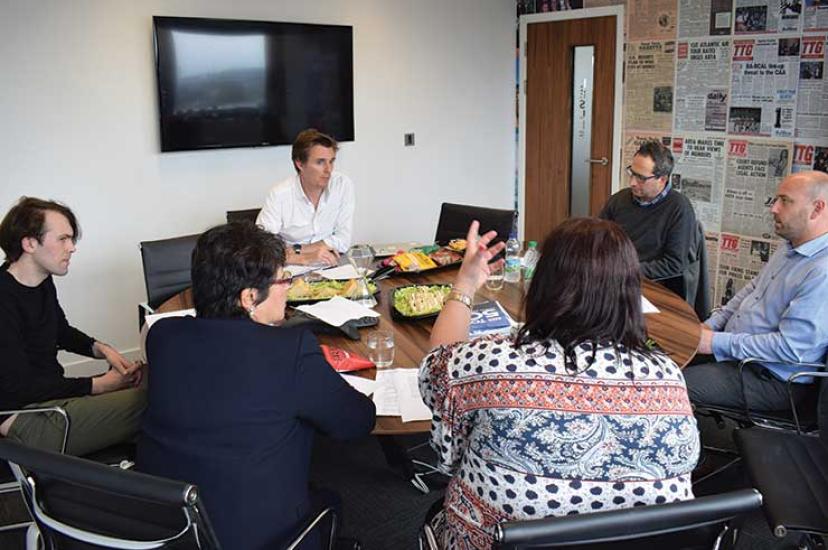
Kicking off the debate, the panel agreed that the ability to personalise the selling process, from initial contact to printing itineraries, was a key requirement they sought from their technology provider.
Danny Sperling, business development manager, Abbotts Travel, said: “We use our website and social media to bring people in. It’s very community based. If we have an enquiry coming in from the web – which we have quite a lot of because we generate such great content – a personal email is automatically sent back. We tend to drive everything back to an email exchange or phone call.”
Technology should be seen and not heard – it should be “sitting in the background”, according to Vertical Systems’ managing director Rob Barker, who said technology should be able to “bridge a gap”.
“One of our most used features in our CRM, which was originally a suggestion by a customer, is a [digital] business card,” he said. “It’s nothing more than a brief description, picture and a biography of the agent, and is instantly attached to that touchpoint when an agent responds to an enquiry. It says: ‘Here’s who I am, I’m a person, we’re not just a faceless website’ – it transitions that very impersonal process into a personal process.”
The ability for platforms to automatically personalise stylish itineraries in a physical form was also agreed upon as an important factor. Sperling argued customers often want to have documents in their hand to make them feel reassured after spending £4,000 on a holiday, and they can offset fears some have over accessing e-tickets in areas with poor Wi-Fi or if batteries fail.
Be social
Technology used “properly” was also cited as key to reinforcing personal relationships that good travel agencies will have established with customers. The argument was made that with online advertising costs rocketing, and in particular bidding for key words, technology should be harnessed to ensure relationships do not dwindle.
“Technology is not just about new businesses,” Barker said, “it’s also about retaining customers. With Facebook and Google advertising costs going up – I think it’s £18 per acquisition, per customer – use technology to keep that momentum.” The content of the digital offering, for example, is key. Sperling said: “I spend a lot of time on digital creation – that’s what sets us apart from everyone else. We run monthly newsletters, client blogs and have an experience of the month.
“We will always drive people to content we’ve created, and say ‘have a look at this blog, or article, on great shopping pieces’. That really works well and gives those readers enough reasons to book with you.”
Meanwhile, video streaming on Facebook Live emerged as a hit with Dawn Wootton, assistant manager, Miss Ellies Travel. “We did an Easter Egg draw on Facebook Live – we had more likes than any other offer on Facebook,” she said. “It was me and a customer pulling a name out of a hat, but we had a couple of hundred people watching it live. They can see we’re real people that way. It was personal, and it was local.”
For Ashley Quint, holiday designer, TravelTime World, posting on a local Facebook page proves effective. “It’s about getting you out there as well as the business. For me it’s about the people [at an organisation], not just flooding [the client with] offers, but being informative and helpful,” he said. “You’ve got to be very local.”
Social media was also cited as an effective way to engage with the trade – not just customers. “We’ve been on this journey for several years… we rarely put an offer on Facebook,” Sperling admitted. “We’re successful on social media, but not in a way you can say it led to ‘X’ number of bookings. But it works well with suppliers; Twitter is a B2B tool for us. For example, we’ll show how Abbotts staff have been out to an evening event. It increases your profile. Client testimonials are also gold dust on social media.”
He continued: “We also follow local businesses. It’s about sharing the love... It builds up that local trust.” Turning tide Questioned on whether all travel agencies should offer online bookability, the trio of agents said this could in fact do more harm than good. Quint noted: “You can’t be everything to all people. The tide has turned. Are you booking online, or are you booking with a travel agent? You can’t be both. Don’t mix the two.”
Sperling added: “There are organisations set up specifically to book online. If you’re going to offer that to your clients, you’re into that world where it’s very easy for them just to compare, compare, compare; it’s very much price driven. But when it’s a person-to-person relationship, the technology you put in place will help back you up on a personal level.”
However, Barker argued that some of the larger travel companies were “big enough to have different skill sets” – he urged agents to “put that personal service across electronically – that’s the best hybrid you can get”. “But it’s got to be relevant to that person at the point in time,” he added.
While it was deemed essential to capture as much detail about clients as possible – something OTAs cannot always get right – Quint warned that agents who focus too much on data capture could put customers off. “For our business, it’s too intrusive for the way we work,” he said. “We do want to get data, but without that data getting in the way of the sales process… otherwise, you can get so involved in the data side that you forget about the service.”
Virtual future?
Asked about the rise of virtual reality (VR), Wootton said she believed it would work best for agents promoting more niche products. “Would it work for people who want to sit down on a beach?” she asked. “It needs to be sexy.” She added that Miss Ellies already uses cruise lines’ 360 virtual tours to train staff. “
We could have a few VR headsets in the office, or run a cruise event. You can sit and talk about a cruise, but until you’ve been on one… You can see the cabins, restaurants, and theatre [in a 360 tour].” As well as a medium that lent itself to niche, or unfamiliar, product, the panel agreed technology could also be used to make clients feel special.
But questions remained over sourcing content: “Are the providers of the experience providing content, or should they be giving camera equipment to agents for when they go on fam trip?” Sperling asked.
Lightening the load
A bugbear for agents, which they believed technology could ease, was administration. Quint said the amount of admin agents have to do had “gone through the roof” and that he sought automation from his technology suppliers to avoid duplications. “It would be good to automate what we do, to make it more streamlined. For example, we sell currency, and have a coach operator – but they have different systems,” he said.
However, Sperling countered that dealing with multiple systems was one reason why customers turn to agents in the first place. For Barker, it was also a question of training and forming the right relationships with technology partners: “You can have the best technology out there, but it’s always about adoption… if you don’t equal your resource investment with your financial investment, you won’t get the solution you want.” Quint summarised: “With good technology, there’s [often] good people behind it.”