







Luxury travel has been one of the most robust performers in the post-pandemic years and its growth shows few signs of slowing down – despite geopolitical and economic uncertainties. But what does this mean for luxury travel agencies and advisors?
Will they continue to prosper in the years ahead and how will the role continue to evolve, particularly with the ceaseless advance of artificial intelligence into all aspects of our lives?
It can sometimes be hard to define luxury travel and it’s often said that it means different things to different people.
In the old days, it might just be somebody who regularly books business class flights and stays in five-star resorts.
While those clients still exist, there is also a whole stratum of well-heeled customers who think nothing of splashing out tens of thousands of pounds, or more, on a single trip.
This has led to the emergence of different business models, which increasingly focus on building relationships with these clients and offering them a “high-touch” personal service.
The value of global luxury travel was estimated at around $2.3 trillion in 2024, according to Credence Research, with annual growth of 3.6% expected in the next few years, which would take it up to nearly $3 trillion by 2032.
With such high figures, it’s no wonder more advisors are choosing to focus on this market.

Luxury agents must evolve their business practices to meet the expectations of today's high-net-worth travellers
State of independence
One of the key changes in recent years has been the growth of luxury travel advisors working as independent consultants (ICs) under an umbrella organisation.
Global luxury travel network Virtuoso has 20,000 advisors across 58 countries, while Global Travel Collection, part of Internova Travel Group, has 1,500 advisors worldwide, including around 250 independent advisors across the UK.
The Global Travel Collection UK office consists of almost 100 staff who support this network, where advisors specialise in bespoke leisure holidays, corporate travel for UHNW clients, and premium travel services for music tours and film production.
Well-established UK-based companies such as Travel Counsellors, Designer Travel and Not Just Travel are also service providers for the increasing number of agents who want to run their own businesses.
But how do these agents stand out from the crowd and find those lucrative luxury clients?
Alex Gavalda, commercial director at Travel Counsellors, agrees the role is “evolving from booking agent to curator, connector and storyteller”.

Advisors are no longer bookers, they are curators with unrivalled insider knowledge, says Travel Counsellors commercial director Alex Gavalda
“Luxury clients can research hotels online, but what they can’t replicate is the ability to anticipate needs and create confidence,” he says. “Going forward, advisors will continue to deepen their destination and product expertise, so they can act not just as bookers, but as curators with unrivalled insider knowledge.”
Virtuoso’s UK & Ireland general manager Karen Joyce says luxury travel is becoming “far more personalised and experiential”.
“We see clients expecting their travel to reflect their individual values, passions and lifestyles. We’ve seen a significant shift towards purpose-driven travel too, whether that’s through cultural immersion, wellness or sustainability,” she explains.
Designer Travel advisor Emma Parry-Thorpe, who recently scooped two awards at the Travel Industry Awards 2025, stresses the importance of “being proactive” for clients and understanding their preferences.
“I know if they like certain seats with extra legroom on flights and I deal with their meal requests and any accessibility issues,” she says.
“Airlines cancel a lot of flights these days so I can react quickly to rebook those flights for them. You can’t beat the knowledge of agents – AI isn’t going to replace me.”
Caribtours’ chief executive Paul Cleary also notes an “explosion” of independent luxury advisors in recent years and expects this trend to continue.
“More and more people are setting up on their own as sole traders under somebody else’s umbrella,” he adds. “It feels very buoyant – all you really need is a small book of good clients who are booking a couple of holidays a year.”
Lounge love
There is also still life in bricks-and-mortar locations it seems, although the trend is much more toward being styled as travel lounges rather than traditional shops.
Upmarket agency Winged Boots has just opened a new lounge in Shenfield, Essex, and plans to work closely with local people and businesses as part of its strategy to become “part of the fabric of the community”.
“Holidays are incredibly personal and people still value face-to-face conversations when making those decisions,” explains managing director David Ox. “Our advisors are trained not just to listen to words but to understand intent, personality and unspoken preferences. No laptop can do that.
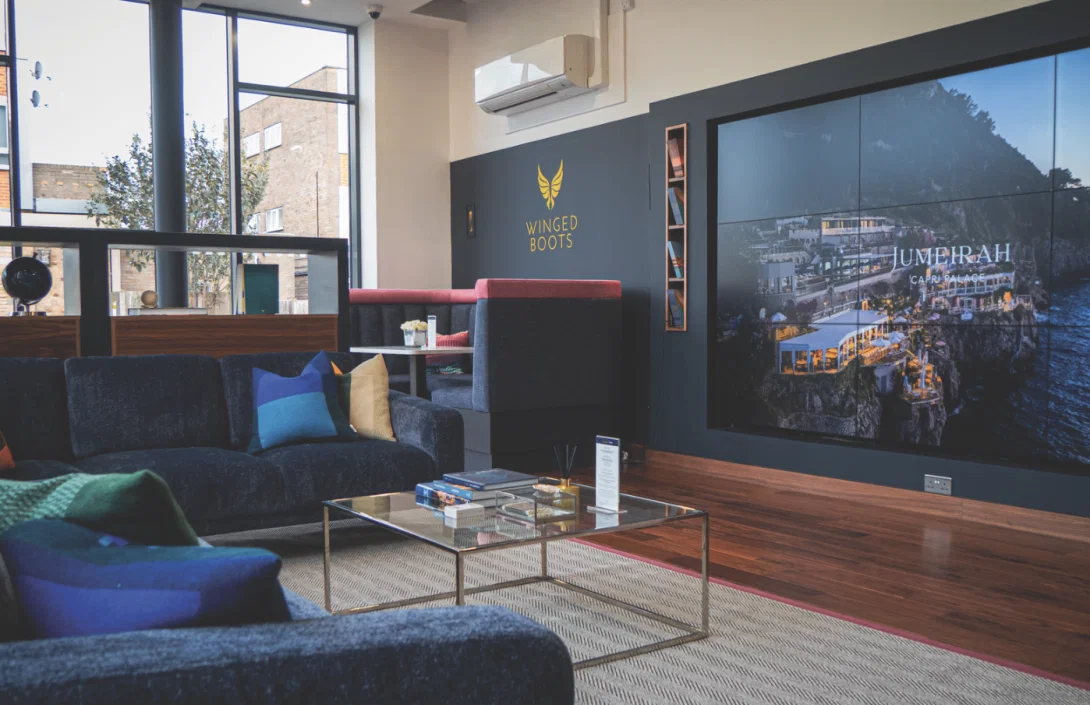
Winged Boots opened its first retail store in October
“Opening the store has given us the space to spend quality time with clients, learn what drives their decisions and build trust. It also means customers know exactly who they can speak to at any time if something goes wrong.”
Another example is Huben Travel, which opened its first high street lounge in Cobham, Surrey, earlier this year having previously worked remotely. The independent agency says it has “reimagined” the traditional high street shop to be “more personal, more inspiring and much more homely” by welcoming clients with a cup of coffee or “glass of bubbles” as they discuss their travel aspirations.
Conversely, some traditional high street agencies have also gone in the other direction, branching out into homeworking or offering an appointment-based system for higher-spending clients who want a more exclusive experience.
Harpenden-based Travel Four Seasons has even set up another brand, Artisan Travel, where clients looking for “bespoke” bookings are charged a £250 fee for a “discovery call”. This is then put towards the cost of the holiday when they do book with the agency.
“We have a team of three under Artisan who are remote workers – it’s worked brilliantly well since we started it a year ago,” says the agency’s founder Sean Fletcher. “85% of clients have gone on to book and we definitely plan to grow Artisan by taking on more agents as we’ve proved the proof of concept.”
Another relatively new player, Club Voyages is just about to open its second shop in Leamington Spa at the same time as continuing to build up its team of more than 20 homeworkers. Managing director Sam Ballard says having a high street presence adds a “layer of authenticity” for the business but adds it’s vital to find the “right position” for any shop.
Deeper relationships
For servicing the wants and travel needs of HNWIs (high-net-worth individuals) or the even richer UHNWIs (ultra-high-net-worth individuals), a new breed of concierge or lifestyle management companies have come to the fore.
“We have been described as many things - a travel fixer, travel PA, adventure pioneers and my personal favourite - travel fairy godmother,” says Rebecca Green, chief executive officer of luxury travel concierge Wanderlux.
“Our model focuses on personalisation, curation, access and advocacy. Traditional agencies often focus on the booking; we focus on the experience. We work extremely closely with our clients to understand not just their preferences, but their values, lifestyle and motivation behind each trip.”

Wanderlux founder Rebecca Puttock describes herself as a 'travel fairy godmother'
As with all forms of selling luxury travel, getting to know the client is at the heart of their success, as well as offering exclusive experiences that are difficult to find and book elsewhere – particularly online.
“We work proactively, building white-labelled experiences that cannot be found online - to entice the curious and adventurous clients even further, as well as showcase how far we can go,” adds Green.
For some high-end companies, travel is just one of the lifestyle management services being offered to an exclusive and limited membership of clients.
Ed Farrelly, director of travel at London-based private lifestyle group Ellidore, says: “Ellidore is not a travel agency; rather we are a lifestyle management business first, with dedicated specialist teams covering travel, events, personal shopping and lifestyle.
“That breadth of expertise gives us multiple touch-points with our members, allowing us to build a complete picture of them as people. We do not just know their preferences, we understand their context.
“This means our service is proactive rather than reactive. If a member has a milestone approaching, we are already thinking about how best to mark it. That might involve sourcing a venue, arranging travel, styling, or curating experiences that fit the occasion.”

Dorsia Travel's Tom Cahalan says its 'extremely rare' for his agency to book a property it hasn't already visited
Cambridge-based Dorsia Travel meanwhile, which is run by former tech entrepreneur Tom Cahalan, who personally knows a thing or two about the HNW lifestyle. But along with wife Lucie, he realised they could create a business planning travel differently to how they had seen it done. They now offer a completely different model: bookings are mostly generated by Tom’s personal and forthright hotel reviews – all based on stays he has paid for himself.
“It’s extremely rare for us to book a property that I’ve never been to,” explained Tom Cahalan. “I’m always very honest in all my reviews and I try to do one a week. We offer an ultra-personalised service to our clients who spend an average of $100,000 per year on travel.
“We only look at doing around 100 bookings a year, which we’re very happy with. I spend about four months of the year travelling, so that averages out at about two bookings a week. We’re not trying to be the next Scott Dunn or A&K.”
Future gazing
As with all aspects of travel, one of the key questions is how AI will transform the sector in the years ahead. Most in the industry seem to be confident that while AI may reshape how they work, ultimately “people buy from people” and the “high touch” nature of the luxury market will not fundamentally change.
“AI is undeniably transforming travel by automating everyday tasks, including processing bookings, delivering instant recommendations and tailoring elements of trips through data-driven insights,” says Virtuoso’s Karen Joyce. “Speed doesn’t always equal reliability, and while AI may be faster, it isn’t necessarily better. Advisors bring the human judgment and context that make recommendations genuinely trustworthy and aligned with travellers’ needs.”
She adds that there are already signs of some travellers growing “more sceptical of content from increasingly sophisticated AI” and are turning back to the expertise and knowledge of human advisors. Virtuoso says it has seen a 76% increase in consumers seeking to connect with travel advisors this year through its website.
“These tools are phenomenal, so they are going to have an impact,” says Dorsia Travel’s Tom Cahalan. “But we are a social species and people like dealing with other people – I genuinely love to talk to people about travel and going through all their ideas. I think at the high-end, it’s going to be ok.”
AI is more likely to “transform efficiency” rather than define luxury, argues Ellidore’s Ed Farrelly. “It can generate endless options, but our members do not want every thing: they want the right thing,” he says. “They want ideas designed around their context, timing and emotional needs. That is why high-level planning is not about information, it is about interpretation.
“You do not create a Savile Row suit with an algorithm, you create it through dialogue. Travel and lifestyle are no different. The best outcomes come from conversation, empathy and long-term trust.”
While AI-based platforms may not replace luxury travel advisors, the tech revolution can certainly help them to better serve their clients and identify more potential selling opportunities.
Travel Counsellor Alex Gavalda adds: “Our in-house AI tool, TC Co-Pilot, helps TCs spot opportunities to engage more personally with clients, but it never substitutes the relationship. These tools also mean our TCs can communicate and engage with clients in more personalised ways, using data and insights to offer exactly the right options, through the channels that the clients want to use.”
Luxury travel is increasingly being built on strong personal long-term relationships between advisors and their clients, which are now going far beyond the transactional nature of the occasional holiday booking. That trend seems only likely to strengthen in the years ahead.
But it’s a time-consuming business, with advisors often working long hours to offer the kind of service their clients have come to expect and appreciate. This may make it difficult for people who want to try to do it as a “side hustle” to their main job.
“It takes time, attention to detail, and a real passion for creating something special,” says Steve Witt, co-founder of Not Just Travel, which has both full-time and part-time advisors. “Luxury travel naturally comes with high client expectations, so agents need to deliver a high-touch, concierge-style service that builds trust and long-term relationships.”
We may be entering a brave new world in terms of technology, but the future looks bright for devoted luxury travel advisors, with a range of different business models catering to upmarket clients, whether that be remote-working, on the high street or a combination of both.
Although whatever path an advisor takes, meeting the expectations of demanding clients will still require plenty of nimble footwork to stay on top of ever-changing travel and lifestyle trends.