



There are instances in life one never forgets. And in the travel industry, we tend to have more than our fair share.
Certainly, over my many years in the business, several come to mind – but nothing comes close to what happened in December 1991.
My previous wife was at university with a good friend, Richard Dowden, who subsequently became the The Independent’s Africa editor. He went on to write a highly-acclaimed book, which was simply titled Africa.
For several years prior to Namibia’s independence, he had badgered me to visit the country. He said I would never forget the experience, and that it had infrastructure – built by the Germans who previously ruled it as a colony (German South-West Africa) – which was better than that of Greece. He felt it offered great potential as a new destination for Sunvil.
I pretty much ignored the idea. After all, why would a Greece specialist want to feature an African destination from which all we ever heard were tales of guerrilla body Swapo, South West Africa’a People Organisation.
However, Richard persisted, and in the end, I succumbed and agreed to visit the newly-renamed independent nation of Namibia.
I had never been to Africa before. Like many in our industry, I tended just to book flights and go to places without much by way of preparation. I hired a minibus on arrival and, with my wife and four young children, drove 3,000km around Namibia weighing up the potential for a programme there.
It was stunning, unforgettable, and, in those days, you could visit the viewpoint above Fish River Canyon – not dissimilar in size to the Grand Canyon – and sign a visitor book confirming you had been there.
I remember the visitor prior to us had signed the book two days earlier. Such a view in any other country, even then, would have attracted tens of thousands of people.
Christmas with the president
On Christmas Eve, we were driving up the Skeleton Coast – a misty and spooky experience, with the Namib Desert to our east and the icy-cold Benguela current in the seas to our west – heading for a camp called Terrace Bay, a fairly primitive place by all accounts.
As ever, by the time we got organised and set off from Swakopmund, we reached Terrace Bay at around dusk. I had booked two rooms there.
The entrance to the camp was blocked by armoured cars, and soldiers stood before the gates. I got out of the car and cautiously approached the guards. I explained I had booked two rooms; I produced my booking voucher.
Stony-faced, they turned me away, saying the camp was closed. I pointed out the minibus, with four young and restless children, and asked where else could I possibly find to stay at that time of night. The conversation went back and forth. Finally, a soldier disappeared into the camp, returned, and said that we could stay.
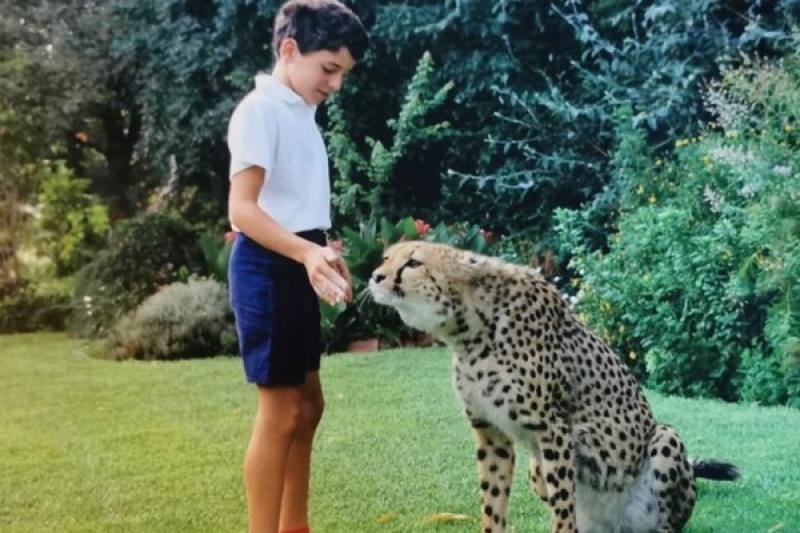
We settled the children into their adjacent room, warned them about the scorpions, and were just about to go to bed ourselves when there was a knock on the door.
A soldier told us we had been invited to sit down to Christmas lunch with Sam Nujoma, the first president of Namibia, who just so happened to be on a fishing trip and was staying at the camp.
’A great modern-day statesman’
The next day, I was duly seated next to Sam Nujoma, along with my wife and children, surrounded by his bodyguards, while eating a traditional Christmas lunch.
We discussed tourism to Namibia, and he was thrilled to hear that I was considering starting a fly-drive programme. We discussed the political scene in Africa, and I said I hoped that Namibia would not have the same problems as South Africa. He gave me his word the white community would be encouraged to stay to help to run the country, that our clients would be safe, and that there would be no tension.
Namibia was the first African country to be featured by what became our Expert Africa brand, and formed the backbone of its programme – now much expanded, of course.
As for me, I have never visited any other African country. I am left, having just heard of Sam Nujoma’s death at the age of 95, with a memory of a remarkable chance encounter with one of the great modern-day Africa statesmen who was, indeed, true to his word that travellers to his country would be safe.
Noel Josephides is chair of Sunvil.