






There are few human endurance challenges tougher than the Marathon des Sables. Participants put up with sand, wind and extreme temperatures while running 156 miles in six days across the Moroccan Sahara.
Travel industry executive Lucia Rowe has just completed the race, on her second attempt, and what makes her achievement even more astounding is that six years ago, she was diagnosed with leukaemia, which is now in remission.
It’s the conditions that make the race particularly demanding, Lucia tells TTG: “The sand, the heat, the lack of hygiene – the environment is properly hostile to humans. That’s why nobody lives there.
"You don’t have running water, or toilets. You sleep with other people in an open-sided Berber tent. And when the sandstorms come, you get completely covered by sand, on your skin, in your nails, in your bones it feels like.
"It’s brutal, and nothing can really prepare you for it.”
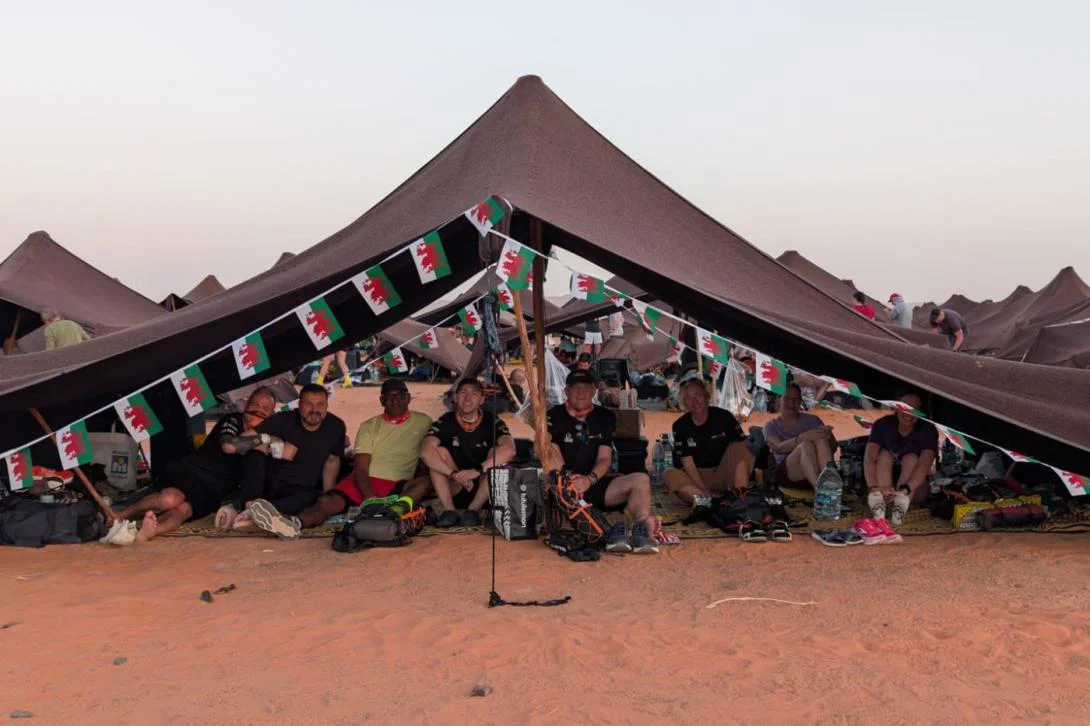
Marathon des Sables participants share Berber tents to sleep at night
A dome of stars
The unforgiving terrain can be hazardous, with sharp rocks frequently causing injuries. But the landscape is also full of interest, says Lucia, and very different to the common misconception that the Sahara is just endless sand dunes.
“The landscape changes dramatically as you go, and there’s definitely beauty in it. And when you’re lucky enough not to have a sandstorm at night, although it’s very cold, that dome of infinite stars goes beyond anything I have seen anywhere in the world.”
Whether she was able to enjoy the scenery is another matter, she laughs, alluding to the constant pain she was feeling. “It depends who you are with. Often you meet extraordinary people with whom you can concentrate on the absolute beauty around you, but you also have to keep your wits about you, because things can go downhill very fast.”
The race is exceptionally well organised, she explains – runners wear trackers and will very quickly be approached by a rescue team in a desert buggy if they deviate from the route.
Last year, the support team were forced to withdraw Lucia on medical grounds – halfway through, her body temperature dropped so severely that she risked hypothermia. Which is why the event felt like unfinished business.
'I was petrified'
“Although it was actually harder to convince not just myself, but also my husband and children, who were so worried. I had survived this awful illness five years ago, and I’m still not clear of it because my type of leukemia is chronic.
“But I had made a commitment to Reuben’s Retreat, to its founder and my great friend Nicola Graham, and I knew I had to try one more time. I felt I had it in me to do it. But I was petrified, I’m not going to lie.”
During her second attempt, there was a period when the odds were stacked against Lucia once more. On top of the pain from countless blisters, she developed a stomach bug and was unable to eat anything. The penultimate day she was literally running on empty.
“My stomach got really bad and I had to be seen at every checkpoint by the medics and given permission to continue. They medicated me so that I could still drink, because if you can’t hydrate, then your race is definitely over.”
Enter a guardian angel
Lucia puts the fact she was able to finish down to the help and support given to her by a fellow runner from Brazil, called Giovanna. “She risked her entire race because she didn’t leave my side for the entire stage," says Lucia. "It wasn’t clear at all that I was going to finish, because we were up against the clock, and I was moving very slowly.
"I begged her to go ahead, but she was adamant. ‘This is my race now, I’m staying with you’, she told me. She was my guardian angel, and she got me through that stage. We arrived at the end stage with only 30 minutes before it closed, and I collapsed straight on to a stretcher and was carried to the medical tent. I wouldn’t have made it without her.”
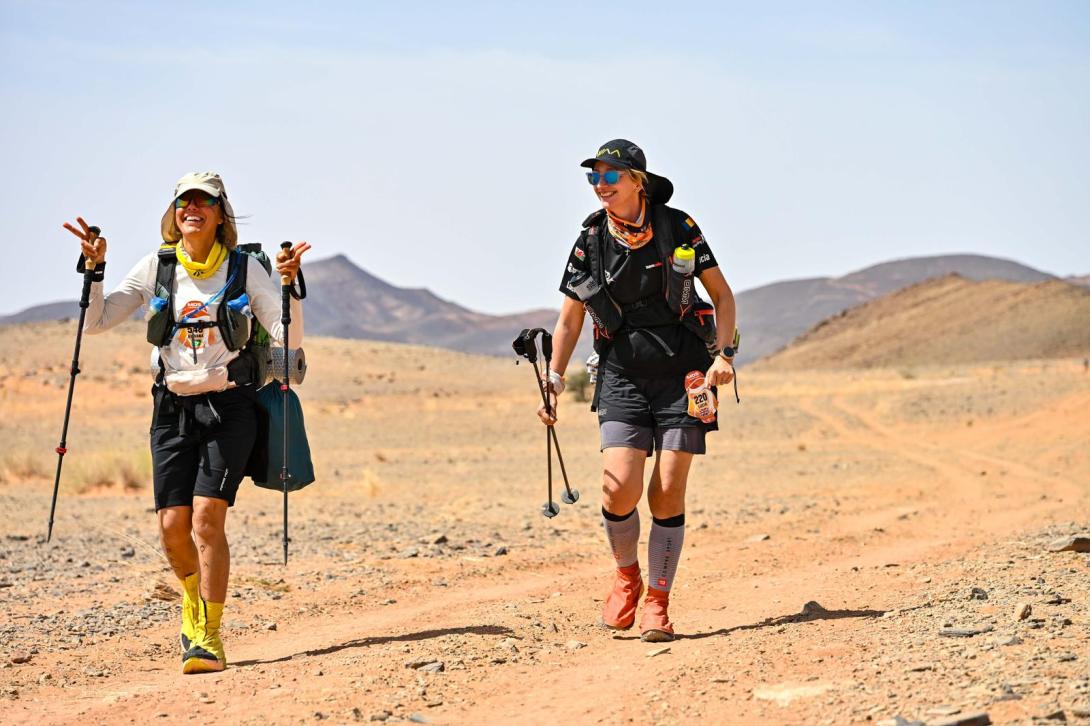
Lucia and her 'guardian angel' Giovanna
And that act of human kindness defines the race for Lucia. “More than the desert and the challenge, it’s about the incredible people and the humanity that you encounter. She was a complete stranger, but she will never be a stranger to me anymore. She’s going to be in my life forever.”
After the medical team had patched Lucia up, she had one more day to get through, and the challenging conditions continued right to the end, with the wind whipping up another sandstorm and reducing visibility. “When I finally saw that finish line, and I saw it late because visibility was so poor, I wasn’t sure it was real. It felt like a hallucination.
"But then I heard the noise and the music and saw all the amazing volunteers supporting us, and even though I was crying constantly, I ran that last bit, hand in hand with two friends I had made, crossing the finish line together.”
The finish line is still in the middle of nowhere in the Sahara, and the triumphant runners need to be coached back to civilisation. But before that, there was a very simple pleasure to be enjoyed – running water.
“For the first time in eight days, we could wash our hands,” says Lucia. “It sounds like such a small thing – and when you think about so many people living without running water – but in that moment, washing our hands and face, it was bliss!”
Connecting with the outside world again
The coach journey back to Ouarzazate, gateway to the Sahara, took about eight hours, and that was when Lucia could finally connect with the outside world, as they entered the realm of having phone signal.
Throughout the race, the only contact Lucia had been able to make with her loved ones and supporters was by filming a daily 60-second video in the emotion pen, which is then sent out via email.
But she wasn’t able to get anything back in return, and so messages flooded into her phone as she was finally able to converse with those back at home.
In the hotel, there was a much-anticipated first shower, “a meal that wasn’t beefy jerky or some other horrible dry food” and a proper celebration with all those who had been to hell and back over the last week.
“When you get home, it takes a while to get out of that constant state of heightened adrenaline and being in survival mode,” she reveals. “It’s recognised as a form of post-traumatic stress disorder when you have flashbacks of the most difficult moments. I underestimated it last year and thought it would be better this time, because I’d brought home the medal, but there’s still a lot of crying and feeling really low.”
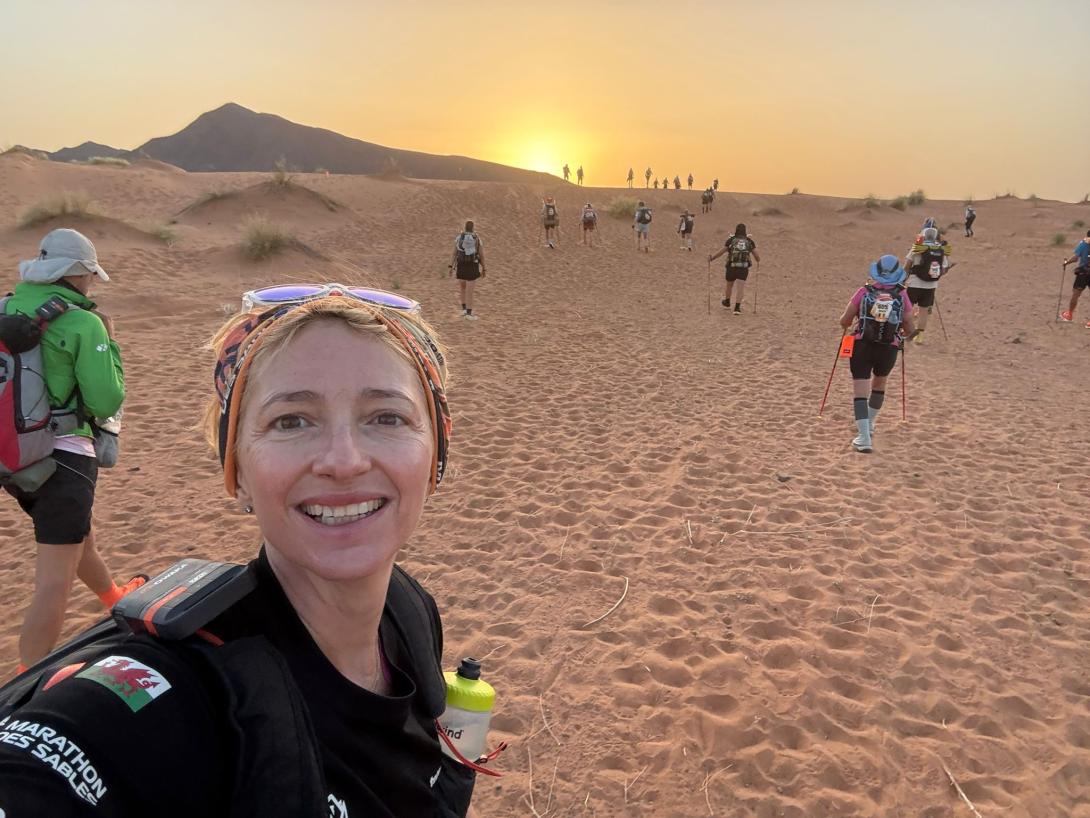
The Sahara landscape was both hostile and beautiful at once
What helped Lucia was throwing herself back into work, and just four days after returning home, she flew out to Skiathos for the third Sustainable Travel Agora in Skiathos, organised by the Greek National Tourism Organisation.
“It was the best recovery possible, being with like-minded people, talking about good things, seeing the amazing progress being made on this small island. The travel industry helped heal my wounds in a way I wouldn’t have thought possible.”
Next target: 100
So, what is next for this warrior woman? Although some people return to the Marathon des Sables year-after-year, Lucia is sure this was a one-off. “Never again – the next time I see sand, it has to be a beach holiday,” she laughs.
Instead, she plans to switch focus to more normal marathon running – with 60 already completed, 100 is a tempting milestone, and a way to continue her charitable mission.
Although she still can't resist the bigger challenges: “In July I’m going back to the race I absolutely adore – a 100km one here in Avebury, Race to the Stones – and that will be for Reuben’s Retreat again.”
Her connection with the Glossop-based charity, which supports families of children living with medical complexities and families who’ve experienced child loss, runs deep. “They were constantly on my mind, because there’s nothing worse than what those families go through.”
This empathy has been sharpened by her own experiences – she was hospitalised with leukaemia at the height of Covid and cared for in a transplant ward, when she had virtually no immunity.
“The fear of getting Covid in the ward, that would have been the end for all of us. I’ve never forgotten that time, and the incredible care I received, and how my life changed after that.
And even though through this ordeal Lucia has pushed her body to its absolute limits, she's been left with a deep sense of accomplishment:
“I guess that’s why I’m doing what I’m doing. Not just for charity, but I’m trying to live my life in a different and more present way.”
You can find out more about Lucia's endeavour, and donate to her fundraising effort, via her JustGiving page.