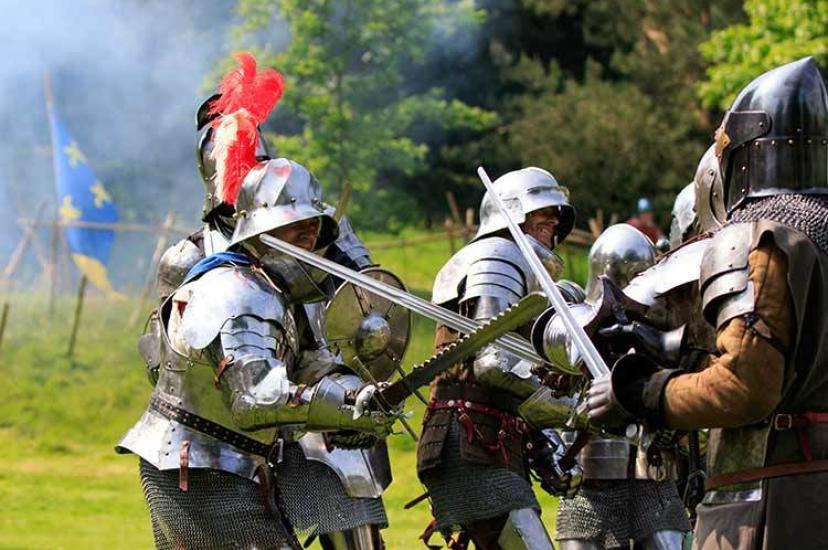
“What should the earl of Arundel do with the French prisoners? Should he show mercy or should it be death?” asks the battle commentator. “Death,” chants the crowd, in the spirit of pantomime participation.
“It’s a sad day when noble chivalry is cut down like this,” returns the commentator. “You’re a rotten audience.”
Battle over, the defeated French retreat to their encampment to lick their wounds, while the victorious English are no less keen to rid themselves of their heavy armour and tuck into a well-earned hog roast.
Barring knights using GroPros and an absence of body parts littering the battlefield, a siege reenactment at Arundel Castle is the closest I have come to stepping back in time.
The West Sussex landmark, parts of which date back nearly 1,000 years, is a picturesque backdrop, set high on a hilltop with views of the South Downs and the river Arun. Over the recent May bank holiday it was invaded by three living history groups; they camped in medieval-style tents, cooked meals on open fires, and dressed the part for the entire weekend. These people have regular jobs – scientists, postmen, electricians – but they share a passion for history that inspires them to recreate it as authentically as possible in their free time – even if that means sweating buckets in armour weighing 60lbs.
“Fifty hours that took me,” says one squire proudly showing me a piece of chainmail armour, handmade with metal washers.
The historical interpreters staged two battles per day, with the “English” taking on the “French”. Talking to me ahead of the event, Paul Ullson, director of the Raven Tor Living History Group, said the aim was to be as realistic as possible: “We use replica weapons and artillery, and black powder wherever possible. It gives a real flavour of what it was like in a battle, when you have cannons roaring and weapons clashing.”
The castle siege weekend is one of a series of events at Arundel that bring different eras of history alive, from Norman knights to 18th-century pirates.
He said the audience participation was key to its success. “Audience members are fascinated by what they see. Reenactments are an important part of our cultural experience at a historic site nowadays. They bring the place alive, especially for children. What child doesn’t want to be a knight or princess?”
Despite the English victory, Ullson assured me the battles were not scripted: “We don’t know what will happen – whoever fights the hardest, whoever uses the best tactics, will be the winner at the end of the day.”