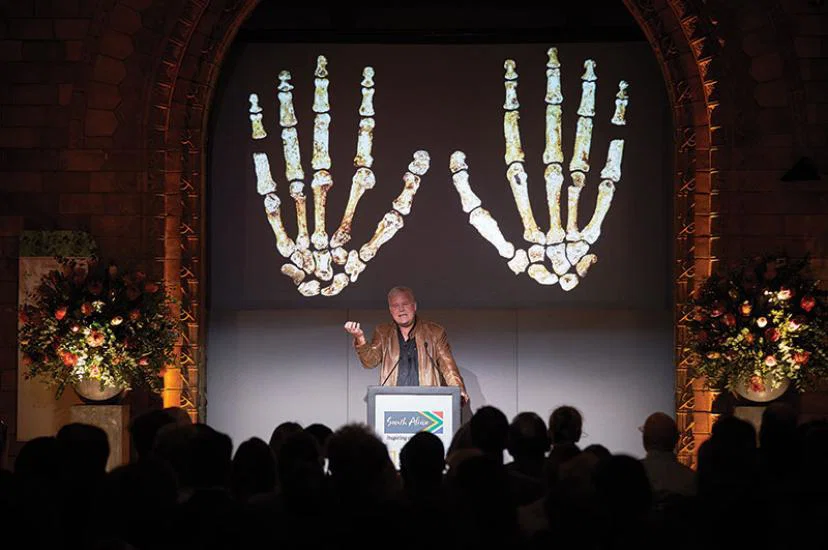
According to fossil specialist Professor Lee Berger, the chance of anyone in his line of work discovering unknown fossils is considered to be less than 1%. So when the paleoanthropologist found the remains of an entirely unheard of species of early human, scientific history was made.
I recently spent an hour among the atmospherically uplit fossils of London’s Natural History Museum, listening in awe to Berger’s story at an event with South African Tourism. Deep in the Cradle of Humankind, one of the world’s most explored fossil sites, the professor made a discovery that adds another piece to the puzzle of human evolution.
The Unesco World Heritage Site is located an hour’s drive from Johannesburg, in Gauteng province. Maropeng is the official visitor centre. Here, visitors can explore an exhibition and the Sterkfontein Caves, where previous discoveries were made. It’s also possible to stay in a hotel at the site and enjoy stargazing experiences.
It was in 2008 that Berger’s nine-year-old son Matthew discovered a fossil – which Berger recognised as a clavicle – at Malapa, a site less than one kilometre from where he’d spent 17 years searching. Further investigation revealed a jawbone and a canine belonging to a child, sparking a vast exploration with a team of scientists who discovered more than 700 new cave and fossil sites.
In 2013, two amateur cavers who Berger had asked to keep an eye out for fossils came to him. They had an image of a fossil they had found “just lying there” in what became known as the Rising Star cave.
Berger had to act fast as there were signs of damage, which he attributed to other amateur cavers treading on the fossils. However, the access route to the cave was a 7.5-inch shaft, which meant he was not “physiologically appropriate” to venture into it himself. Via Facebook, Berger assembled six scientists to excavate the chamber.
Berger said: “By the end of the 21-day expedition, we had thousands of remains. Ultimately, we found around 1,550 elements from something like 15 individuals.”
In September 2015, they announced a new species, Homo naledi.
On March 18 this year, the Naledi fossils will be on display at the science centre at the Cradle of Humankind. Berger also promised that new discoveries and revelations would be announced on that day.
“We didn’t stop exploring and we have discovered more,” he said.
With the Cradle of Humankind an easy day trip from South Africa’s largest metropolis, it’s an opportunity to see human history unfold before your eyes – and one well worth recommending your clients take the time to explore.