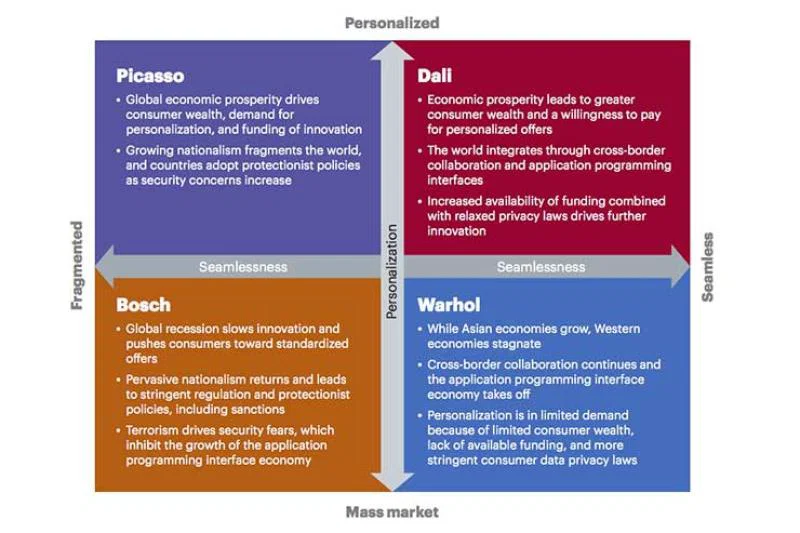
The report, which commissioned US-based management consultants A.T. Kearney, is called "What if? Imagining the future of the travel industry" and identifies trends of personalisation and seamless travel as key drivers of success in the next five to seven years.
"Living in the Dali scenario, travel becomes faster, cheaper, and safer. People benefit from less security controls at borders and have real-time information about unexpected events such as flight delays."
The report also outlines four different world scenarios of the future, and warns that the emergence of protectionism and populism could hinder future commercial opportunities across the industry.
Based on these two key trends, Amadeus and A.T. Kearney have identified four future-looking world scenarios that travel companies needs to prepare for today, if they are to maximise future growth and success tomorrow:
- The Picasso scenario is built on a fragmented world marked by the rise of populism and by heightened security concerns. This has the effect of making more travel destinations off-limits. Even so, most parts of the world enjoy economic growth. Companies invest in innovation to reach more customers through mobile channels, and this interaction enables businesses to provide more sophisticated personalized offers.
- The Dali scenario assumes that both social attitudes and economic prosperity create a more favourable environment towards sharing data. This brings about more relaxed privacy laws and lighter regulation, which allows for greater personalisation of travel. Living in the Dali scenario, travel becomes faster, cheaper, and safer. People benefit from less security controls at borders and have real-time information about unexpected events such as flight delays.
- In the Bosch scenario, business costs rise across the industry as companies struggle to comply with a mosaic of different legal, tax, labour and data protection laws. We are confronting a fragmented world based on protectionism and distrust. Facing Bosch’s political environment, travellers seek comfort in trusted brands and book directly with well-known travel providers.
- The Warhol scenario is characterised by seamless and not personalised travel that considers the implications of strong economic growth in Asia, giving rise to a large middle class with more dis-posable income for travel and leisure. Travellers would rather go for low cost, mass-market travel instead of having personalised options even in a world free of barriers.
To download the report, click here