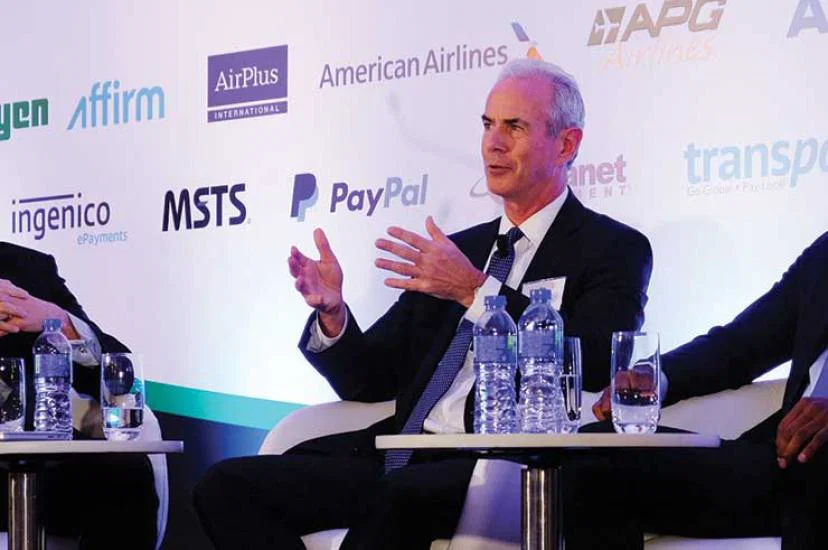
But this is what happened with WEX – a payment company founded in 1983 but since the early 2000s found itself “scaling” rapidly alongside Priceline as the OTA market grew exponentially.
“They appreciated our travel expertise,” recalls Jim Pratt (pictured above), senior vice-president and general manager, virtual payments. “Priceline wanted a software agreement,” he says, adding that at the time he was surprised, as WEX hadn’t considered itself a technology company.
“Their technology guys really pushed us, they said you really need to keep up with us. It was difficult at first, but now we have that mindset. That was one of the benefits of working with OTAs at such an early stage.”
Pratt joined WEX in 1998 – a tumultuous year entrenched within the dot-com bubble. The bubble burst a few years later and Priceline survived. Pratt was hired to help create virtual cards – which back then were not classed as such.
“As Priceline became bigger, the hotel chains got onboard. They were the first to adopt virtual payments, around 2005-06. We then received hotel leads, which were saying they didn’t want to deal with cheques,” Pratt recollects.
Competitive edge
Today, both Priceline and Expedia – which is also a customer – dominate a significant part of the online market, but Pratt believes virtual payments should play a part in all travel sellers’ strategies.
To date, it works with a number of major names in the UK and European markets, and he argues the technology is essential for travel companies that seek flexibility.
“Virtual gives the ability to make smaller travel agencies more competitive. If you’re small, and if you’re booking a hotel in a remote region, they want some guarantee of payment. If the agency has virtual cards at their disposal, once you get authorised that’s as good as money in the bank. We can help small agencies make payments over borders and seamlessly without friction.
“Virtual cards also offer reconciliation. And anti-fraud is built in, which helps suppliers.”
With geopolitical issues and terrorist attacks disrupting traditional holiday booking patterns and destinations, Pratt believes agents must be able to contract new suppliers quickly and efficiently.
“Payment technology is part of the solution. If you want to switch from France to Thailand for example, you don’t have to worry about payments.”
Remote control
The new wave of low-cost, long-haul carriers, such as Norwegian, IAG’s Level and AirAsia X are also altering the landscape. South-east Asia, for example, is becoming more accessible and Pratt says that in 2016 it had 58 million inbound visitors, compared with 31 million in 2015.
“Places like Cambodia and Thailand are 70-80% up for inbound,” he adds. “Experiential holidays are on the rise, and [being driven] by the millennials and baby boomers. People are staying in more remote areas. The low-cost carriers aren’t going to stop. Business models may need to be tweaked. It may not be AirAsia X, or Norwegian, but it will be somebody.”
There are other payment technology firms focusing on the UK’s fragmented market, but Pratt does not perceive it to be overcrowded. “The competition keeps us on our toes. It’s good. The concept of virtual cards in the travel space is becoming more broadly known and accepted. But go back to 2007, our sales people had to spend a lot of time educating. Now, no time at all; now we’re competing on capability.”
However, one advantage WEX possesses is the fact it has its own bank, he adds. “We’re highly regulated and understand regulations. We’ve also been careful to recruit a lot of people who come out of travel, such as OTAs. We’re focused on travel payments.
“We’ve been lucky over the years to work with terrific customers. And in Europe, we plan to continue to expand. We’re here for good. We’re extremely pleased with the reception we’ve had in Europe, and we want to learn about what travel agencies are doing. We want to help travel firms focus on booking more travellers, not to worry about payments.”