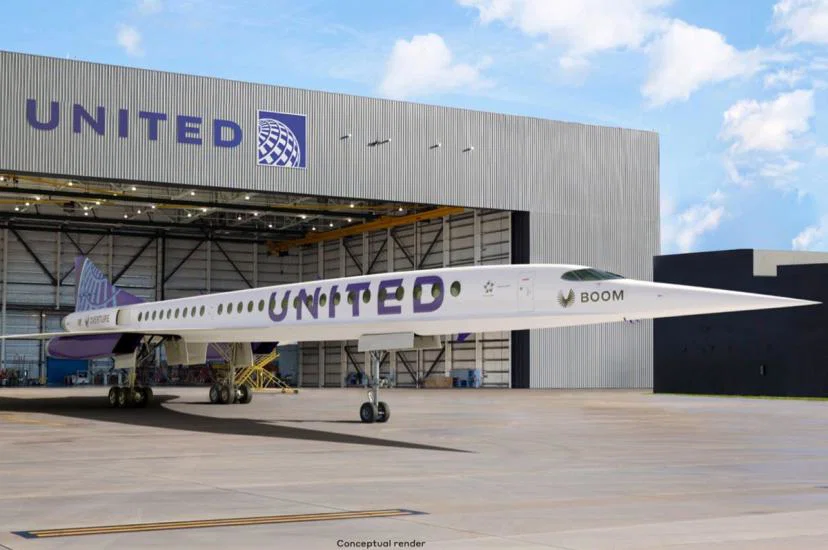
Since then, there has been no replacement for the supersonic passenger aircraft, which enabled passengers to reach New York from London in three and a half hours, literally beating the clock. Now, with the strangest timing – in the middle of a pandemic – comes news of a possible revival of this most premium form of travel.
United Airlines and Japan Airlines have placed their faith in Boom, a Denver company developing an aircraft called Overture that looks like Concorde, flies as fast, and is due to enter passenger service in 2029. United is buying 15 with an option for 35 more, while JAL has pre-ordered 20.
Perhaps more importantly, the US military is backing the project “for government applications”, so it looks like a goer, but before you start offering it up to clients in New York day trips, there are some things to consider.
Boom must overcome two major design headaches that led to Concorde’s demise. Firstly, Concorde’s fuel consumption meant it was an expensive ride. Those flown by British Airways had 100 seats, but Overture is aiming for 65-88 in its narrow cabin, so even fewer people will be paying for it at the pumps.
Overture will run on Sustainable Aviation Fuel, which overcomes another big objection to Concorde, but SAF is currently more expensive to produce than kerosene, so that’s something to be resolved. Questions also remain about supersonic flight’s effect on the ozone layer, with some saying travelling at 60,000 feet is damaging and others, including Nasa, disputing this.
Secondly, there is the noise issue. Concorde’s roar was brutal even at subsonic speed, but its sonic boom meant it could only reach its 1,350mph cruising speed over the ocean. Boom says new engine design means Overture’s impact on airport communities “will be similar to the long-haul aircraft it replaces”. Let’s hope so.
But where will it fly? Concorde’s New York service was successful, but BA’s fleet often spent days doing pleasure flights tearing around the Bay of Biscay where the noise could not upset anyone – not a sustainable experience.
Like Concorde, Overture is a niche project; its noise footprint means only big city pairings with ocean between them will be viable. London-New York is the obvious choice and that would surely work in a limited way again.
Overture’s range is stated as 4,888 miles and United has said San Francisco-Tokyo is another goal, but this transpacific route is just over 5,000 miles, so there’s some tweaking to be done in the design to make that viable.
While they’re figuring that out, the new kids on the transatlantic block, JetBlue, will from this summer be offering £999 return business class fares across the pond that includes a lie-flat bed in a mini cabin. That will bring down fares across the board and combined with reduced corporate demand post-pandemic, perhaps make for an even starker difference in pricepoints once Overture begins flying.
Moreover, the subsonic premium experience generally is far, far better than in Concorde’s heyday, with lie-flat beds now standard and mini-cabins becoming the norm. Airbus A350 and Boeing 787s already in service offer better cabin air quality than, for example the Boeing 747s that were Concorde’s competitor. It all adds up to an experience that helps kick jet lag and dents the appeal of the supersonic proposition.
That said, travelling at nearly 1,500 miles an hour at 60,000 feet is a great human achievement. Concorde was a noisy gas guzzler that, despite its futuristic look, was originally conceived in the 1950s. If a 21st century design means Boom can overcome Concorde’s drawbacks and Overture is genuinely as green – and as quiet – as the manufacturers make out, then I say bring it on – let’s go back to the future.