




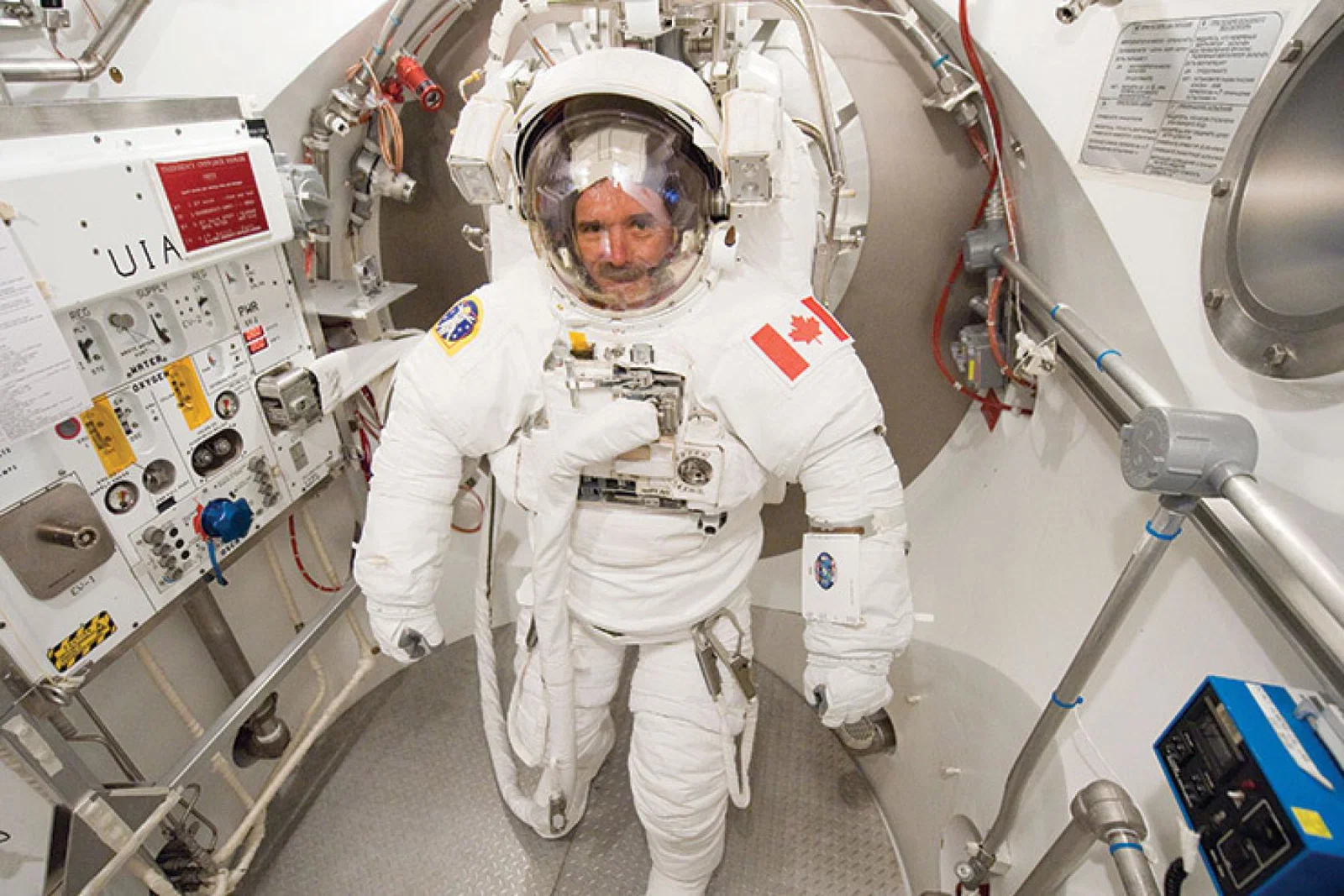
It’s not a statement many people can make. But then, most people haven’t been an astronaut, lived in the International Space Station (ISS), or performed a space walk.
Chris Hadfield, the keynote speaker at next week’s Advantage Conference, has done all these.
“One of the beauties of being an astronaut is that you get to see the whole planet from everywhere,” Hadfield is telling me, and I can hear the smile in his voice as he recalls his experiences. We are speaking on the phone – he has just landed, ready to set off for his stint at the Advantage conference.
In London, the rain is sliding down the windows, and it’s another grey day, the capital’s majestic skyline lost in a drizzling mist. But such is Hadfield’s passion that I am transported with him as he describes the awesome story of being a spaceman.
“With the space station, the window is the floor... like a glass bottom boat. It gives you a whole different view. It makes it so much more intimate.”
“You see the world directly overhead, and straight down, and from all different angles. With airlines you’re always looking outside the side windows, but with the space station, the window is the floor – it’s like a glass bottom boat. It gives you a whole different view. It makes it so much more intimate.”
It is a view that Hadfield says is constantly changing for those lucky enough to see it. With the ISS speeding around the planet at the rate of five miles a second, Hadfield recalls he would circumnavigate the globe 16 times a day, but it was different every time.
“We went from one side of the solar system to the other, and every day the seasons would change from winter to summer on different parts of the world.”
His description of the Earth as countries experienced the different seasons is particularly poetic. “With Ireland, you could actually see the greening of the land. You really can see the colours of the emerald isle. And then when we went over my home country of Canada in winter, it would be monochrome; it was as if we were looking at a black and white photograph.”
Down to earth
It was the constantly changing seasons which helped whet Hadfield’s desire to travel on earth. He might have been where few others have, but he also has a long bucket list of places he wishes to visit on the planet too.
“Seeing the world in all conditions, you get a real feel for the world,” he says. “I love the colours of the reefs in the Bahamas or the atolls in the south pacific. And the outback of Australia is just so beautiful, because of its colours.
“I’m longing to see the north end of the south island of New Zealand, where there is a huge river valley, and you can see all of wine country.
“You spill your water and it floats right in front of you. And then you have to try and capture it before it floats too near to a computer.”
“And the Sahara,” he adds. “Large deserts dominate [the world] from space. They’re just so big and empty, and they’re so colourful – oranges and purples – because of their huge dryness. I haven’t spent any time on a great desert. And probably by the end of one day there, my desire would evaporate,” he laughs, “but seeing the Sahara from orbit, it’s just such an enormous part of the world.”
Hadfield wasn’t always an astronaut. He learned to fly at the age of 15, and joined the Royal Canadian Air Cadets as a teenager, later flying for the Canadian Air Force. From there he was later selected by the Canadian Space Agency, where he served as a Nasa astronaut for 21 years, completing three space missions, including his last stint in space in 2012-13 where he spent five months in the ISS, before retiring.
Born explorers
With both Richard Branson and the billionaire founder of Amazon Jeff Bezos competing to bring space travel to the masses though, Hadfield could soon be able to return to space as a civilian. But would he want to?
Hadfield is enthusiastic about both space programmes, and confident that space travel will be achieved before long. He is also confident that moon holidays will be a definite reality one day – “I think it’s quite similar to the Antarctic,” he says. “If you look at 120 years ago, it was almost impossible to go there; it was extremely dangerous. Now people holiday there all the time. It might not be luxury, but it’s adventure. The moon is something that’s impossible now but could be there in the future.”
Hadfield does confess though that he probably won’t be first in the queue to try out the new space crafts. “It would be like asking Lewis Hamilton if he would like to come for a ride in your sports car and to pay a lot of money [for the pleasure],” he laughs. “I’ve already had that discovery and wonder.”
I ask if he is concerned that mankind could ruin the moon if it becomes a tourist hotspot, but he dismisses the suggestion. “That’s not a reason to not do things. You can make a mess of anywhere.
“With the perspective [that space travel] gives you, it makes you more alive in terms of our responsibility. We tend to think the world is an unlimited resource; when you see it [from space] you realise that it’s not such a big place.
“We’re not perfect but at the same time we’re adventurous. We’re explorers. We learn to walk before we learn to talk. Evolution gave us the ability to go and see for ourselves,” he adds. We might be explorers, but that doesn’t mean that even the best astronauts don’t struggle with the simplest things in space.
Hadfield says the hardest thing about not having gravity was “anything requiring two hands”. Namely, putting his shoes on. “You have to exercise otherwise your muscles and bones will waste away, so we had to exercise for two hours a day on special equipment,” he explains.
“You normally just have socks on, because you’re not on your feet. [On Earth], you would normally sit down, put both hands on your own foot and you do your laces up. In space, as soon as you have two hands on your trainers, there’s nothing to hold on to. “Every single time I’d do one shoe, I would be upside down and then the other floated off. It was frustrating, but every time I was laughing.
“A lot of things are easier though,” he adds. “You can tumble effortlessly, you feel like you suddenly have super powers. And you can play with it. I’ve lived in space three different times, but I still play with it – you fly or you somersault, or you spill your water and it floats right in front of you. And then you have to try and capture it before it floats too near to a computer,” he chuckles.
Ground control
It was Hadfield’s joy and wonder at being in space that captured the hearts of so many on earth, with his social media postings of videos and images from his missions. This included one particularly memorable performance: his cover of David Bowie’s Space Oddity on YouTube, which received more than 31 million views.
He is humble about the reaction, stating simply: “I was delighted.” “I think it helps people experience that type of travel,” he adds. “In the same way that you listen to the Blues when you’re in New Orleans, and it helps to explain the place to you a little bit; it helps people to see space exploration for what it is.” And what of the reaction of the great Starman, David Bowie himself? “He corresponded back and said he loved it, and that it was the most poignant cover he had ever seen,” Hadfield reveals proudly. “I’m so pleased to have given him some joy.”
Despite his delight at being in space though, I suggest to Hadfield that there must have been moments when he was somewhat terrified, such as on his space walks. “I was an astronaut for 21 years, and the vast majority of time I was on earth preparing, practising. So by the time I was doing something, I was pumped and aware, because it’s so much more profound and exhilarating,” he insists.
“To be alone [in space] – I loved the experience, the immensity of the universe all around you. If you’re terrified, you miss the experience. I feel very lucky.”