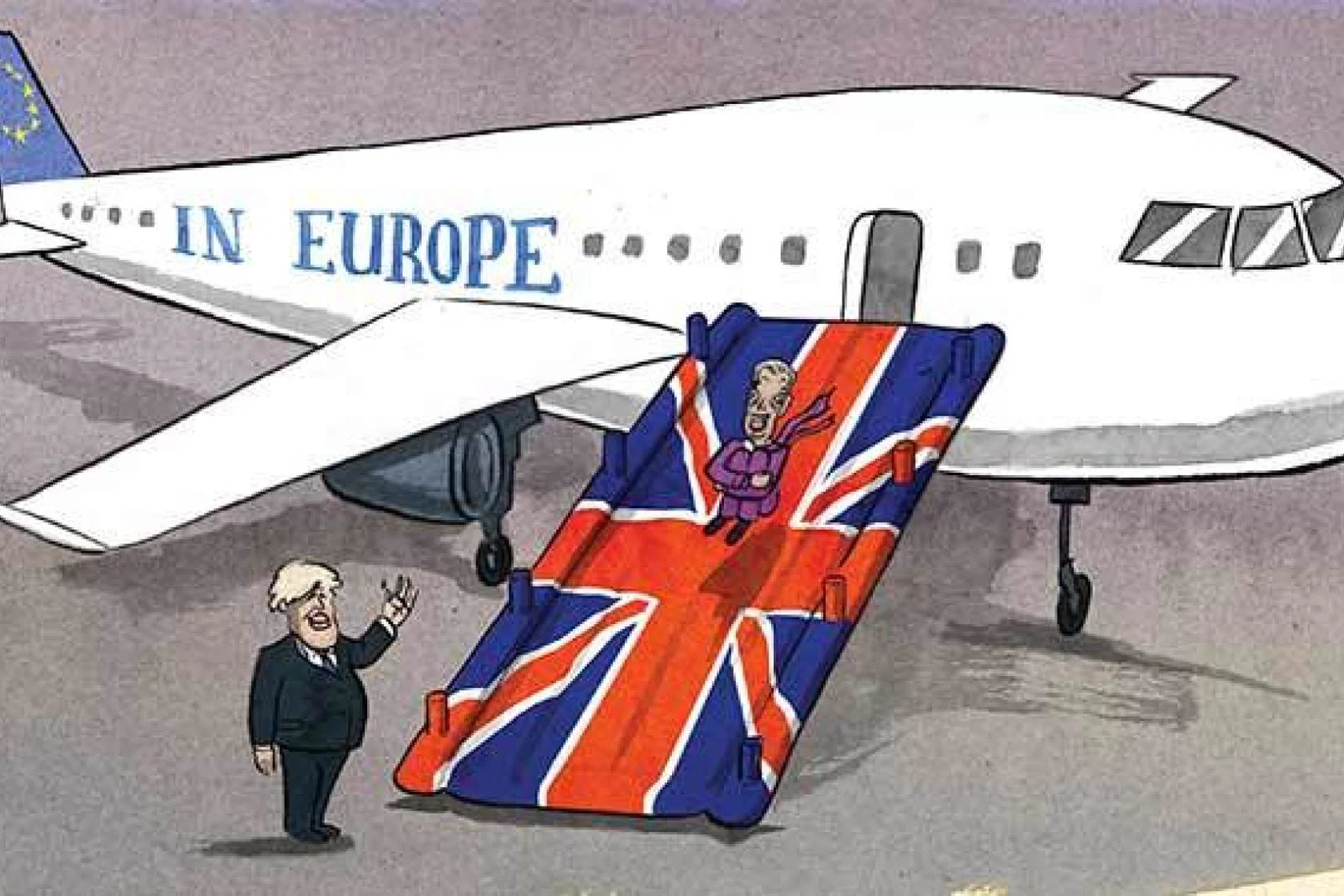
So what would it really mean for the travel industry if we did leave?
According to McCall, the first difference would be a notable rise in the cost of our holidays. In a column for the Sunday Times on February 14, she wrote: “It was the EU that gave airlines the freedom to fly across the continent... That led to a dramatic fall in fares – around a 40% cut – and the number of routes increasing by 180%... How much you pay for your holiday really does depend on how much influence Britain has in Europe.”
But is she correct? Not according to Ryanair chief executive O’Leary. He is outspoken in his support of the “in” vote, but that didn’t stop him admitting to an ITV News journalist last week: “I don’t believe leaving the EU will cause air fares to rise."
Andy Cooper, former head of external affairs at Thomas Cook and now an independent consultant, points out that if Britain left the EU, airlines would have to renegotiate new individual licences with each European country, rather than operating under one single agreement as it does now. And this could indeed lead to increased costs. “Airlines would have to get a separate licence like they do with Switzerland,” he explains. “It could lead to them relocating their business to another EU member state to make things easier for them. It’s all the bureaucracy – and there is of course a cost attached to it.”
“If [David] Cameron really believed there would be an economic doomsday why would he even choose to hold a referendum?”
Robert Oxley, Vote Leave
His arguments are supported by Alan Bowen, legal advisor to the Association of Atol Companies. “Ryanair and easyJet operate internal flights, which will now be subject to local laws,” he says. “They would have to reach new agreements with each country, which might then turn around and say they want to focus on boosting their own local airlines instead. It’s a huge negative from an airline perspective.”
Those in the Brexit camp though are keen to highlight O’Leary’s comments. TTG spoke with Nigel Farage – perhaps the most opinionated and certainly the loudest of the anti-EU campaigners. “O’Leary, who probably knows more about pricing in air travel than anyone, has said that pricing won’t rise, so I trust that,” he counters.
“Also, when you think of the sheer volume of business that the UK does with airlines, there is absolutely no reason at all that air fares should go up – we are a customer. Airports in France for example want us to fly to them – there’s no reason that we couldn’t just have one deal for 27 countries,” Farage insists.
Robert Oxley, spokesperson for anti-EU campaign Vote Leave, adds: “We have a bilateral agreement between the EU and non-EU countries [for airlines] which would remain in place.
“It’s just scaremongering to say that flights would cost more – utter rubbish,” he insists.
Currency challenges
There are, however, other reasons that experts believe a Brexit could lead to a hike in holiday prices. This is largely due to the belief that sterling would fall dramatically – as evidenced by the pound falling to a seven-year low last week, in the wake of David Cameron announcing the date for the referendum and Boris Johnson stating his support for the “leave” campaign.
Hannah Clipston, partner at Thomas Eggar, says the value of British currency is a “major concern”. “Some believe that the pound would plummet by as much as 15-20% if the country votes to leave the EU, making foreign travel more expensive for British citizens,” she adds.
Oxley however rubbishes this as more scaremongering. “What’s been happening to sterling is being driven by the rising price of the dollar and [the slowing economy] in China,” says Oxley.
“The idea that it’s simply down to the vote to leave is quite absurd. If [David] Cameron really believed there would be an economic doomsday why would he even choose to hold a referendum? I think they’re desperately looking to scare people to stay in.”
Farage, on the other hand, concedes there may be a fall in our currency, but that this would still be a positive. “Sterling may fall a bit but it’s falling already. So holidays might become a little more expensive – tourism in the UK would be fantastic – it works both ways,” he insists.
Of course it is not just holidays that would be affected by the depreciation in sterling.
“The big merchant banks have said if we left, the pound could fall to $1.15 [down from $1.40 currently], and fuel is priced in dollars when you buy it,”
Alan Bowen
This could explain why the airlines in particular are keen to push the “remain” agenda, because in other areas they could actually benefit if the UK exits the EU, significantly because of the implications of what would happen to EU Regulation 261, which deals with flight compensation for delayed passengers.
As Rebecca Thornley-Gibson, partner at ASB Law, explains: “261 comes from an EU directive, and we have to respect that directive. But if we withdraw from the EU the potential right to compensation could be removed because there’s no relative UK act in respect of flight delay compensation.”
Cooper highlights that airlines would still be liable for at least one section of the route for any journeys to and from EU countries.
“UK airlines would still have to compensate if flights were coming from within Europe, the same way that the US airlines have to. So they would still have liability on at least one sector,” he insists.
The fear though is that airlines, which are recognised as being influential lobbyists within government, could then use their might to persuade ministers to alter – or even drop – any similar legislation that was put forward to replace 261 in the UK. “They may get to choose what we want to keep and what we don’t,” says Bowen.
Package travel concerns
There are also concerns about other EU directives and what the impact of Brexit would mean for those that relate to the sector – namely the Package Travel Directive. The UK of course already has a relatively rigorous protection scheme in the form of Atol. But as Bowen highlights, the new package travel regulations are set to protect an additional three to four million people, such as those who buy holidays using click-throughs on websites. “I would only hope we don't go backward,” he adds.
Oxley though is adamant the UK could still adopt the new measures. “There’s no reason why we couldn’t still have it – a lot of consumers think extra protection for passengers is a good thing,” he insists.
“These regulations that are decided at Brussels often end up coming out as Frankenstein’s monster as they have to suit the interests of 28 countries, and they’re not always in the best interests of the UK. But there’s nothing to stop us on this international agreement – it just needs to be based on the [premise] of what’s in the best interests of Britain. The fear that all this would disappear overnight if we left the EU is ridiculous.”
Indeed, Oxley is insistent that a number of laws would still remain. “It’s hugely wrong to think that the decisions by the EU would disappear overnight – that the UK suddenly wouldn't have maternity rights for instance. But we should be deciding the rules which govern us. There’s a huge democratic deficit in Brussels.”
Who gets your vote?
For every argument to stay in, the Brexit camp are ready with their counter points – “there are a lot of salacious arguments being made,” insists Farage. But to have so many top figures in travel united in their passion to remain is a convincing argument in itself – even if some of the points they make seem a little far-fetched. This includes Long’s suggestion that Britain leaving the EU would be a threat to security.
“I am very happy that when we are looking at security we can see all the foreign ministries are aligned,” he told The Sunday Times in reference to the horrific Tunisian terror attack last June. “That’s only helpful in terms of us ensuring we protect the security of our travellers.”
Oxley’s response? “It’s very difficult to describe my disdain to comments like that. It’s just one more form of scaremongering. It’s seeking to gain political capital on what was a profound tragedy.”
For Cooper the argument is simple. “The whole travel industry should be voting to stay in – why wouldn't they want to? The consequences of coming out are so great that in spite of where you stand on immigration and other issues, it’s almost irrelevant compared to the amount of legal work that would need to be sorted if we were to come out.”
This of course will be just one of the many elements to consider come June 23. Which way will you be voting?
What the travel bosses are saying about Brexit
Carolyn McCall, chief executive, easyJet
“The EU is not perfect and it does need reform… but remaining within the EU means that the UK can directly influence the rules governing the single market – rules that affect our industry and our passengers.”
Peter Long, former chief executive, Tui
“[I had] many first-hand experiences of seeing how European governments, through their foreign offices, collaborate and work together in a crisis… It would not be like that if we weren’t in a situation where we were as Europe working together.”
Richard Branson, founder of Virgin Atlantic
“[If Britain left the EU] it would be a very, very, very, very sad day. I think it would be very, very damaging for Great Britain… I think it would be the start of most likely the break-up of the European Union.”
Willie Walsh, chief executive, IAG
“I am in favour of the UK remaining in the EU but it needs fundamental reform.”