“I had friends that had never been on a cruise and didn’t get it, but I took them for a day [ship visit] and they all said that it was nothing like they imagined,” he recalls. “Of the 39 million people that take a holiday in the UK, 37 million have no clue what the [cruise] industry is about, and we need to communicate that to them.”
Bouldin believes it is the industry’s collective responsibility to drive this message. “Not enough people [in the sector] are doing enough to attract new customers,” he says. “The industry as a whole needs to be doing more; 2016 is the first year since I came into the sector that we have grown new-to-cruise, and that’s partly down to Harmony [of the Seas] being on the front page of The Times. The industry needs to look at how they market to the audience – to think about what they’re offering their product to someone that hasn’t cruised before, who may not understand offers such as onboard credit.
“We have to have some new thinking,” he urges. “The industry needs to remember the scale of the challenge. Bringing new ships in doesn’t just bring new people.”
On exactly how Royal plans to communicate its own message, Bouldin is tight-lipped, revealing only that “we’re going to go for a slightly different approach next year”.
“It’s about what our sales team are doing. It’s important what offers you have. All our activity will be aimed at showing people what that is. Next year it’s about blowing people’s socks off,” he grins.
“When I started in the industry, the average age of a cruiser was 59. Now it’s 55, but the average age for Royal Caribbean is now 42.”
Ben Bouldin
The challenge for Royal – as well as for many in the cruise sector – is in making sure that it’s the younger generation whose socks are blown off. Bouldin admits that, as with competitor lines, Royal “wants to attract a new generation of cruise”, but he insists the line is already achieving this. “When I started in the industry in 2014, the average age of a cruiser was 59. Now it’s 55, but the average age for Royal Caribbean is now 42 – it keeps coming down.”
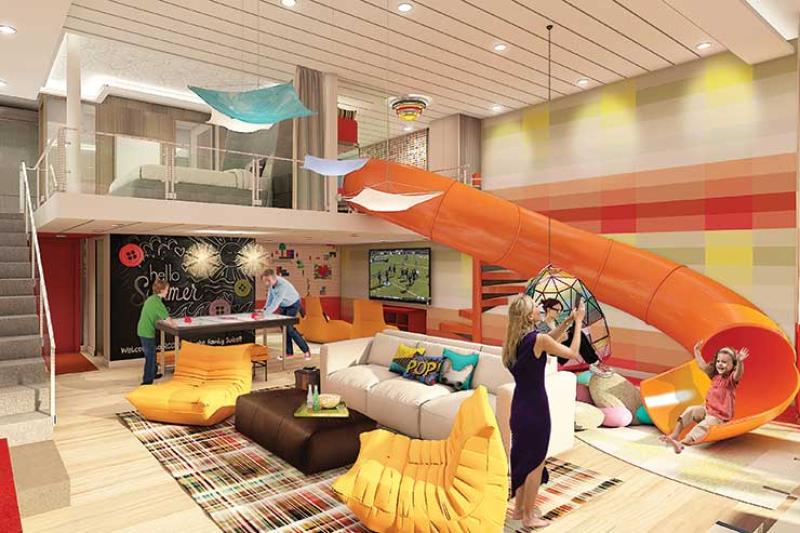
And with innovations like Royal’s two-level Ultimate Family Suite debuting on Symphony of the Seas – complete with a slide from the children’s bedroom to the living room below, a floor-to-ceiling Lego wall and an air hockey table – the line’s average age looks set to continue sliding downwards.
“Symphony is Harmony [of the Seas] on steroids,” says Bouldin. And it is on this factor that the line will focus, in a move away from how sister ship Harmony was promoted, which attracted headlines for being the world’s largest ship. Bouldin acknowledges with a smile that size isn’t everything: “For a new family considering a holiday, ‘the world’s biggest ship’ isn’t going to make them choose cruise,” he says. “That’s not the angle that we’re going to take with Symphony.”
Wider repertoire
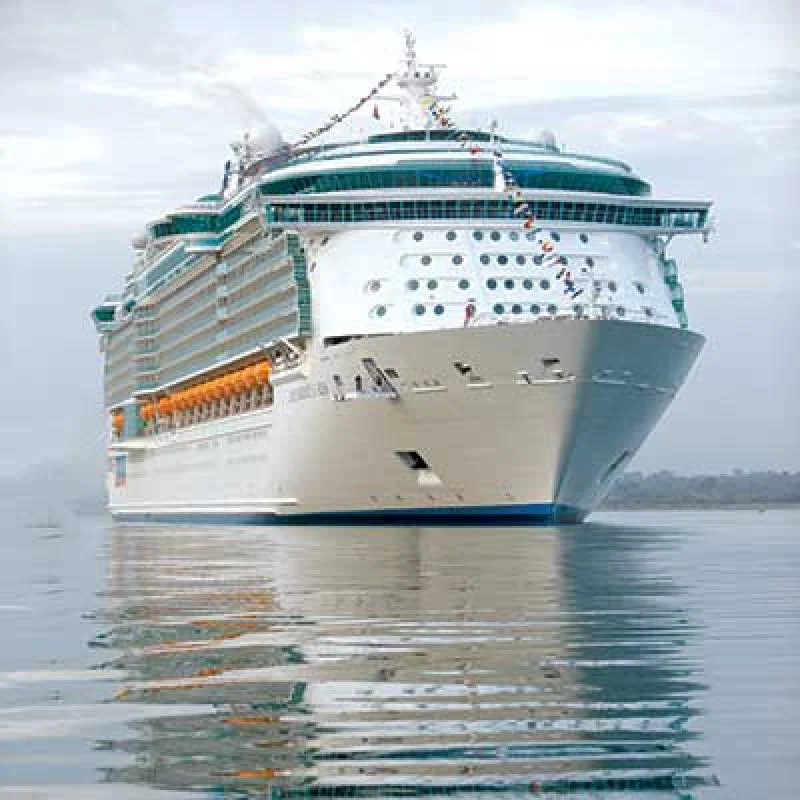
Of course, it’s not just Royal’s newest ships that are innovating. UK favourite Independence of the Seas is also undergoing a multimillion-pound refurbishment next April, with new onboard features set to include a trampoline zone, laser tag arena and waterslides. “The changes on Symphony compared with Harmony are less dramatic than the changes from the old Independence to the new-look Independence,” Bouldin reveals.
I raise other innovations that are being introduced into the sector, such as Norwegian Cruise Line’s all-inclusive offering, which it introduced in April. But Bouldin suggests this is not a route Royal is likely to go down. “In 2015, we became the first in the Royal [Caribbean Cruises Ltd] family to offer all-inclusive – we tried it out for Wave, offering select drinks, soft drinks and gratuities, and it was very successful. We included it in four campaigns out of six in 2016 and we had a great year. The message worked well for consumers – but we were also seeing the impact onboard.”
And this impact, says Bouldin, worked less well: “[It led to] higher pressure on bar service, higher pressure on customer service capability, on queue lengths and serving time. It’s not just about putting people on ships – it’s about ensuring that they have the best experience, and thinking ‘will they come back?’. So we took the tactic that it was a promotional mechanic, but for us it wouldn’t work to do it full time.”
Instead, Bouldin will have his hands full focusing on raising awareness of Independence and Symphony. But while 2018 will be a busy year for the line, Bouldin admits that 2017 has not been without its challenges.
In addition to grappling with the continued political aftershocks following last year’s Brexit referendum result, the travel industry has also had its fair share of company failures and natural disasters to contend with, including most recently Hurricanes Irma and Maria, and the devastation they wreaked across the Caribbean and Florida. Royal’s parent company Royal Caribbean Cruises Ltd was quick to react, bringing aid and medical supplies to affected islands. Bouldin says he was impressed by both his company’s reaction (RCCL committed to matching donations up to $1 million to aid relief efforts) as well as that of its guests, many of whom contacted the company to ask if they could help.
“It makes you recognise how good your company is when you go through times like that,” he says.
“We have to have some new thinking... Bringing new ships in doesn’t just bring new people.”
Ben Bouldin
Political turmoil
Elsewhere, the ongoing political situation in Barcelona, Europe’s largest cruise port, regarding the dispute over Catalonian independence, is continuing to raise concerns among some in the sector. And with Symphony set to launch in the Catalan city next year, Bouldin admits that the line is watching the situation “closely”. “It’s an incredible destination for the industry as a whole – everyone needs to keep an eye on it. It’s a concern. We just have to watch it. And we always have a plan B,” he adds.
Either way, Bouldin is confident that Symphony will live up to Royal’s strapline: “where extraordinary happens”. His overall aim, though, is to recreate for others “the best family experience” he witnessed himself onboard Anthem of the Seas with his own children. “We were on [skydiving simulator] RipCord by iFLY,” he recalls. “There’s no age limit, so my two-year-old son did it. He absolutely loved it. There’s a photo of the rest of us watching him, and the bewilderment on our faces is just brilliant. It was the best family experience we’ve ever had. That little moment – that’s what our ships have,” he smiles, “the ability to deliver dozens of those.”