




Royal Caribbean Group chairman and chief executive Richard Fain may be fiercely competitive with other cruise lines, but Covid has altered those relationships slightly, as evidenced by the group teaming up with Norwegian Cruise Line Holdings (NCLH) to develop “enhanced” health and safety standards for the cruise industry – an extraordinary move for the long-time rivals.
But an unprecedented global pandemic necessitates unprecedented actions and Royal Group, like all cruise lines, is desperate to resume operations safely. At the time of writing, the group had cancelled all sailings up to and including 31 October, but this could yet change again.
“Our plan is to get cruising as soon as?we feel we can do it properly,” Fain tells TTG editor Sophie Griffiths. “We wont rush that. Our guests and I are desperately anxious to get back. I’m getting letters and emails every day to that effect.
“We have to make sure we have the correct protocols in effect. It will depend on finalising those, the development of the disease and the steps governments and people are taking.
“There’s been a dramatic increase in our knowledge. Testing and treatments are radically better and vaccinations seem to be making good progress.”
THE A TEAM
To develop these protocols, Royal Group and NCLH have assembled The Healthy Sail Panel – co-chaired by governor Mike?Leavitt (a?former secretary of health and human services) and Dr Scott Gottlieb (former commissioner of the US Food and Drug Administration, who helped attract “other high-calibre members”).
These members include experts in public health, infectious diseases, biosecurity, hospitality and maritime operations.
“We and Norwegian shared the same goal of having really strong protocols,” Fain explains. “And we set our sights for the panel as the real A team.
“We’ve worked closely with Norwegian, and the panel has worked amazingly hard. One of the things that characterises Royal Group people is passion. When we watch this panel work, they seem to have taken this on just as thoroughly. They are very innovative.”
And knowledge-sharing with other lines goes further too. “We have others observing and we share information. We offered to licence our eMustering (electronic mustering) system for free to any other line that wants to use it. And other lines are sharing with us too."
KNOWING THE DRILL
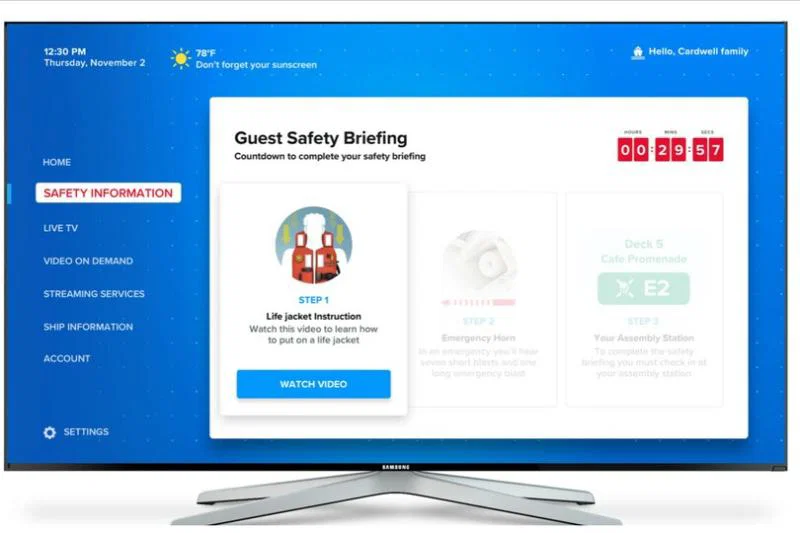
So what changes can Royal Group guests expect onboard? The above mentioned eMustering for starters – known as Muster 2.0.
The traditional muster drill?(only previously updated once in the past 100 years) will be replaced by a new digitised version, offering a “faster, more personal approach” with “higher levels of safety”.
It is already being trialled on Tui Cruises’ ships sailing out of?Germany. Fain says the system had actually been under development before the onset of Covid, but “by chance” the virus has made the system more “valuable”, as it does away with the traditional process of passengers crowding together at the muster station at the same time “and often not paying much attention”.
Instead, passengers will now be able to watch the safety video via their phone from their own stateroom before “wandering to the muster station at a time of their choosing”.
Passengers will need to show they have visited the muster station and know where to go in an emergency, however, by checking in with a member of crew manning the station, as well as logging it in the Royal app.
“From our initial trials, compliance is actually higher than it was before,” Fain?reveals. He adds: “The result is people like it better and they get more personal information, and you eliminate that one?congregation. It’s gone wonderfully and we plan to roll the system out across?the group.”
EVOLVING PROTOCOLS
So what else will be different for Royal Group passengers? Fain admits there have been a lot of questions from guests about what the new protocols will be, but insists they’re still being worked on. He also expects protocols to relax over time, as the technology and knowledge about Covid?evolves.
“At the beginning, you will probably see more use of social distancing and masks,” Fain explains.
“When we had 9/11 everyone was very careful about what you could bring onboard. Nail clippers would be taken off you. That was the early protocol… although we’d send you six humongous steak knives to your cabin for your steak dinner,” he laughs. “But we worked away from that.”
Fain says the company has an opportunity to fine-tune procedures, unlike airlines.
“Other industries have continued to operate so they’ve had to put protocols in place right away,” he muses. “We have the luxury of trying out protocols, considering them and putting together a holistic package. They?interrelate.
“So we’ve been developing our protocols in conjunction with our blue?ribbon (expert) panel and we would?expect to be coming out reasonably soon with a much more comprehensive and holistic [method].”
Ahead of the curve Fain explains that Royal Group was already developing Covid-appropriate protocols before the virus even came about.
“Excalibur (technology programme) has helped us with seamless check-in, which today we would call touchless. We have photo-recognition software. You just show your passport. There’s no need for physical contact or filling out forms.
“The other advantage is it gives us more information about where people are, allowing better contact tracing. So that technology is very helpful.”
Fain doesn’t believe the design of ships will change dramatically post-Covid, however.
“So far when we’ve looked at design, there aren’t so many things that need to change,” he reveals. “We’ll probably start by not filling the vessel – with staggered arrival or dining times.
“I don’t envision huge changes, but we would have had changes anyhow. A cruise last year was very different to a cruise two years ago.
“It will be an evolution rather than fundamentally different. That doesn’t mean we wont make changes, but I don’t think there will be wholesale changes that you or I would notice.”
Fain adds there are some technological advances that have been “put on the backburner” due to Covid.
“We’ve had to slow down some of the technology projects that we otherwise would have liked to have done during this period. I’ll keep those under my hat, though… you might not copy them, but somebody else might!”
TUNE IN!
Hear more from Richard Fain in a live Q&A session during TTG’s How do we get people travelling again? seminar TODAY (10 September). Register at flymy.co.uk/events