

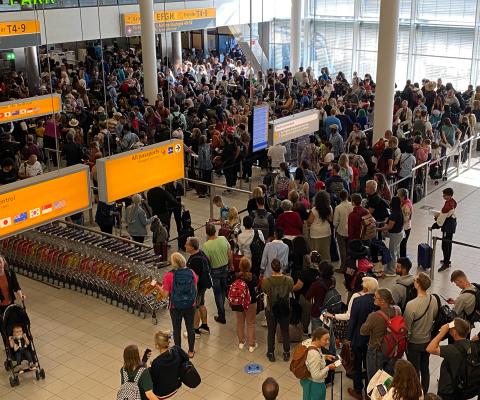

That was the message from travel and aviation leaders on both sides of the pond, who came together on Monday (7 June) to call on Boris Johnson and Joe Biden to come to an agreement on reopening travel between the UK and the US this summer.
Heathrow chief executive John Holland-Kaye said time was now of the essence, with the UK government committed to further easing its Covid restrictions from 21 June and the US looking to do the same by 4 July.
"We’re at a critical moment," he said. "This is the point [at which] they should be showing the benefits of the vaccination programmes they have led. That’s what reopening the transatlantic corridor would do. And if not now, then when?"
United Airlines chief executive, Scott Kirby, said a UK-US travel corridor would serve as a template for the rest of the world, and stressed carriers could step up capacity within four weeks to capitalise on the peak UK-US travel season. "Every day that goes by is a day lost for the recovery," he said.
Roger Dow, president and chief executive of the US Travel Association, said that the G7 summit – which will be held in Cornwall over 11-13 June – would be a "prime opportunity" for the UK and US to set an example. "I think the rest of the world will follow," he said. "But we need a date to shoot for or we’ll keep kicking this can down the road."
Virgin Atlantic chief executive Shai Weiss said it was time for the UK to capitalise on the vaccine dividend it has earned or risk being left behind as the rest of the world opens up. "The G7 is the opportunity," he said, adding a decision should be made no later than 4 July.
The panel was asked about the UK government’s cautious approach to reopening foreign travel, particularly in the aftermath of its decision to remove Portugal from its green list, and whether travel’s pleas were falling on deaf ears.
Sean Doyle, chief executive of British Airways, branded the decision "disappointing" and said it illustrated how travellers "deserve more consistency" from their governments.
He added opening a UK-US travel corridor was an opportunity for both administrations to net a significant economic boost for their countries. "There is a risk that if we don’t open, there will be much more at stake than holidays," he said, calling on the governments on both sides of the Atlantic to look at the issue "though that lens".
A key topic was whether the UK government was making politically-motivated decisions on travel rather than data-driven ones; Holland-Kaye said that although Westminster’s caution did offer people some reassurance, its stance would ultimately be unsustainable.
"We have to open up at some point," he said, highlighting the risk-based approach put forward by the government itself to do just that. "We’re just asking them to follow the guidelines they’ve set. It’s economically and politically important to show there is a prize for taking the lead on vaccination.
"With Covid, we know we’re going to be living with it for a long time. We need to take a risk-based approach. There is no zero-risk way of living with Covid. The UK and US can take a global lead and show there is a prize."
Holland-Kaye described the UK and the US as the "poster boys" for vaccination programmes globally, highlighting how rates of infection in the US continue to fall as the rate of jabs go up. "It also shows other countries there is a benefit [to vaccination] such as reopening their economies."
’We’ve got to go for it’
The panel were united in their belief that a UK-US corridor could be opened up now on the basis of vaccination, supported by testing for those people yet to be fully vaccinated against Covid-19.
Delta Air Lines chief executive Ed Bastian said: "If you’re vaccinated, you should be free to travel. If you’re not, you can take the same care with a test."
He said over the past two to three months, Delta’s aircraft had been operating at full capacity with no evidence of Covid transmission. "We’re going to open up the world, and this is the corridor to get it started," he added.
Doug Parker, chief executive of American Airlines, said that he envisaged a UK-US travel corridor based on vaccination or testing, or both if that’s what it required to "get this started". "I believe we’re all prepared to start this up with vaccination required on both sides," he said.
Doyle said the effective UK-US travel ban at the moment was taking both a big human toll and also an economic toll, with families still separated after more than a year and businesses suffering the consequences of not being able to trade normally.
"The second runway at Heathrow was closed today [Monday]," he said. "It’s the first time since the Second World War we’ve had such limited movements. We’d urge [Joe] Biden and [Boris] Johnson to seize the initiative. We can set the pace for the resumption of travel, we’ve got to go for it."